Historical Resources
Primary Source Readings
The readings below are from a past institute but may prove useful as background information:
- Plato to Montaigne ( pdf)
- Copernicus to Descartes ( pdf)
- Kepler, Galileo, and the Catholic Scientists ( pdf)
- Newton and the Anglo-American Context ( pdf)
- The Early Enlightenment ( pdf)
More Primary Sources
- The Ptolemeic Model ( pdf)
- Ptolemy, That the Earth Performs No Progressive Motion ( pdf)
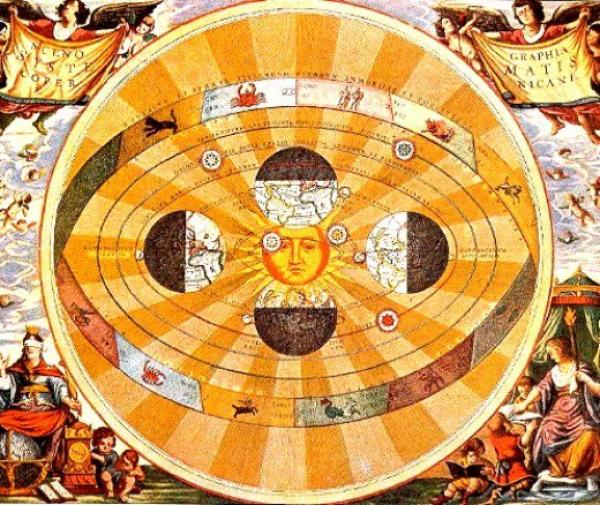
- The Copernican Model: A Color Engraving ( pdf)
- The Copernican Model: Color Engraving the Second ( pdf)
- The Copernican Model: A Page from De Revolutionibus ( pdf)
- Models of the Universe Riccioli Almagestum Novum ( pdf)
"Anima Mundi (The Soul of the World)"; illustration from Robert Fludd's Utriusque Cosmi (1617) (
File- Detail of "Anima Mundi" ( pdf)
- A Newton Manuscript Page ( pdf)
- A Quote from Newton with Questions for Analysis ( pdf)
- Frontispiece, Wilkins, Discourse Concerning a New World (1640) ( pdf)
- Some Illustrations from Wilkins, Mathematicall Magick (1648) ( pdf)
- Copernicus to Pope Paul III ( pdf)
- Letter of Galileo to the Grand Duchess ( pdf)
- Documents from Galileo's Trial ( pdf)
- Francis Bacon's Epistle Dedicatory to James I ( pdf)
Books:
Introductions to the Topic
- James R. Jacob, The Scientific Revolution: Aspirations and Achievements, 1500-1700
- Betty Jo Teeter Dobbs and Margaret Jacob, Newton and the Culture of Newtonianism
Additional Books:
- Bennett, Jim. London's Leonardo: The Life and Work of Robert Hooke. Oxford ; New York: Oxford University Press, 2003.
- Bono, James J. The Word of God and the Languages of Man: Interpreting Nature in Early Modern Science and Medicine. Madison: University of Wisconsin Press, 1995
- Force, James E. and Richard H. Popkin, editors. Newton and Religion: Context, Nature, and Influence. Dordrecht ; Boston: Kluwer Academic, 1999.
- Grant, Edward. “When Did Modern Science Begin?” The American Scholar. Vol. 66, No. 1, (1997): 105-113.
- Harkness, Deborah E. John Dee's Conversations with Angels: Cabala, Alchemy, and the End of Nature. Cambridge, U.K. ; New York: Cambridge University Press, 1999.
- Harkness, Deborah E. The Jewel House: Elizabethan London and the Scientific Revolution. New Haven: Yale University Press, 2007.
- Huff, Toby E. The Rise of Early Modern Science: Islam, China, and the West. Cambridge, UK ; New York: Cambridge University Press, 2003.
- Irving, Sarah. Natural Science and the Origins of the British Empire. London ; Brookfield, Vt.: Pickering & Chatto, 2008.
- Jacob, Margaret C., and Larry Stewart. Practical Matter: Newton's Science in the Service of Industry and Empire, 1687-1851. Cambridge, Mass.: Harvard University Press, 2004.
- Krebs, Robert E. Groundbreaking Scientific Experiments, Inventions, and Discoveries of the Middle Ages and the Renaissance. Westport, Conn.: Greenwood Press, 2004.
- Kuhn, Thomas S. The Structure of Scientific Revolutions. Chicago: University of Chicago Press, 1996.
- Leitz, Robert C. and Kevin L. Cope. editors. Imagining the Sciences: Expressions of New Knowledge in the "Long" Eighteenth Century. New York: AMS Press, 2004.
- Margolis, Howard. It started with Copernicus: How Turning the World Inside Out Led to The Scientific Revolution. New York: McGraw-Hill, 2002.
- Moran, Bruce T. Distilling Knowledge: Alchemy, Chemistry, and the ScientificRevolution. Cambridge, Mass.: Harvard University Press, 2005.
- Roob, Alexander. Alchemy and Mysticism. London: Taschen, 2008.
- Reeves, Eileen Adair. Galileo's Glassworks: The Telescope and the Mirror. Cambridge, Mass.: Harvard University Press, 2008.
- Shapin, Steven. Leviathan and the Air-Pump: Hobbes, Boyle, and the Experimental Life. Princeton, N.J.: Princeton University Press, 1985.
- Westfall, Richard S. Never at Rest: A Biography of Isaac Newton. Cambridge [Eng]. ; New York: Cambridge University Press, 1980.
- Whitfield, Peter. Astrology: A History. New York: Abrams, 2001.
On the Influence of Printing:
- Suarez, Michael F. and H. R. Woudhuysen, eds. The Oxford Companion to the Book. 2 vols. Oxford and New York: Oxford University Press, 2010.
- Eisenstein, Elizabeth L. The Printing Press as an Agent of Change: Communications and Cultural Transformations in Early Modern Europe. Cambridge: Cambridge University Press, 1979.
- Febvre, Lucien, and Henri-Jean Martin. The Coming of the Book: The Impact of Printing 1450-1800. London: Verso Editions, 1984.
- Frasca-Spada, Marina, and Nick Jardine, eds. Books and the Sciences in History. Cambridge and New York: Cambridge University Press, 2000.
- Additional Bibliography ( pdf)
Web Resources
- The Galileo Project - The Galileo Project is a source of information on the life and work of Galileo Galilei (1564-1642). It is hosted by Rice University. The goal of the website is to provide hypertextual information about Galileo and the science of his time to viewers of all ages and levels of expertise. The site includes information about Galileo's life and science, information about other scientists of the time, and information about the context of Galileo's science, incldue patrons and religious issues.
- Museo Galileo - Museo Galileo is the website of the Istituto e Museo di Storia della Scienza [IMSS], an international institute for the study of the History of Science, combining a noted museum of scientific instruments and an institute dedicated to the research, documentation and dissemination of the history of science in the broadest sense.
- The Virtual Museum - pages of the Museo Galileo provide an online tour of the IMSS's collection of scientific instruments, including items used by Galileo. There is a wealth of information about the Scientific Revolution and resources that can be used in the classroom, inculding a simulation of using Galileo's telescope.
- Internet Modern History Sourcebook: The Scientific Revolution - The Internet History Sourcebooks are collections of public domain and copy-permitted historical texts for educational use. Subjects covered in the The Scientific Revolution include: Traditional Aristotelianism, New Medieval Analyses of motion, The Challenge: Astronomy in the 16th Century, Galileo Galilei: The Turning Point, Philosophy of Science: Induction/Deduction, The Creation of Classical Physics, New Medical Theories, and Scientific Institutions.
- Scientific Revolution - A diverse and engaging introduction to the Scientific Revolution prepared by a University of Florida historian. The provides an overview and background to the Scientific Revolution, bibliographic essays, outlines, timelines, a glossary, biographies of major sources, well organized links to primary and secondary sources, manuscript and archive sources, and books on-line.
- Nova: Galileo’s Battle for the Heavens - Website to go with a PBS documentary. While you cannot watch the program here, you can access digital versions of Galileo’s experiments that allow participants to make observations and draw conlusions. The site contains much other useful information.
- Tycho Brahe Museum - Website associated with the museum located at the site of Brahe’s home and observfatory in Denmark.
- The European Enlightenment - This site is designed as a learning module in the form of a "research textbook." The module provides more information and in more detail than the average freshman level world cultures/history/civilizations textbook. It is meant to be a resource for students to extract overall background but with enough detail so that students can approach sophisticated and creative assignments. It includes the story of the Scientific Revolution and some primary sources.
- The Newton Manuscripts - at the National Library of Israel.
- The Newton Project - This collection features published and unpublished writings by Sir Isaac Newton translated and transcribed. They are organized by topic, such as Alchemy, Theology, and Science. There is also biographical information.
- Historic Trials - Galileo Introduction to and sources on Galileo’s trial.